Alberti's Algorithm: A Painter Reads De Pictura in the Age of AI
In 1435 Leon Battista Alberti wrote De Pictura, the first book to treat painting not as a guild secret passed hand to hand but as a system anyone could learn. I came back to it recently for an unlikely reason: the machines.
Watch an image generator turn a sentence into a finished picture and it is hard, as a painter, not to feel something between awe and vertigo. What steadied me was Alberti. He was after the same thing the machine is after, a dependable method for producing a convincing image, and he got there first, by about five hundred years.
His central move was to treat the picture as a construction. "First of all," he writes, "on the surface on which I am going to paint, I draw a rectangle, which I regard as an open window through which the subject is to be seen." From that window he builds his costruzione legittima: orthogonals converging to a vanishing point, a floor of receding squares, a mathematics of space that works regardless of the painter's individual gift. It is, in the plainest sense, an algorithm, a procedure that reliably turns three dimensions into a convincing two. When people describe the "latent space" inside an image model as a vast grid in which every possible picture already has an address, I hear Alberti's grid, scaled up past anything he could have imagined.
But Alberti did not stop at construction, and this is where he still holds something the machine does not. Book II turns to istoria, the painting that means something, that arranges figures and gestures to carry a human story. Book III insists the painter be educated: geometry, yes, but also poetry, history, the company of thoughtful people. The mathematics was never the point. It was the floor you stood on so you could reach for something higher.
That order of priorities is exactly what I feel missing when an image arrives in thirty seconds. The construction is now free; the machine has turned Alberti's hardest-won technical achievement into a default setting. What it cannot hand you is the istoria: the reason the picture should exist, the judgment about what is essential and what is noise, the cultural memory that lets an arrangement of figures mean something to another person. Those still have to be supplied, and so far they can only be supplied by someone who has done the looking.
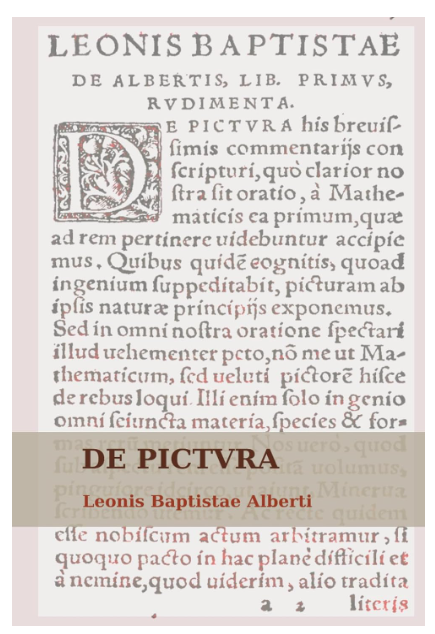
This is also why I went back to Alberti in the original. Every translation makes choices, and those choices quietly soften his precision; the Latin says exactly what it says, in the spare technical voice of a man describing how a thing is built. Reading it that way changed how I understood him, and I cared about it enough to prepare an edition of the Latin text so it would stay in print and in reach. Working through it line by line was its own version of the lesson here: no shortcut stands in for going to the source.
So I read Alberti now not as a historical curiosity but as a reminder of where the work actually lives. The perspective system that made him famous has been automated. The thing he thought mattered most, the union of technical means with human meaning, has not been, and I suspect cannot be. A machine can open the window. It still takes a person to know why the view is worth painting.
If you would like to read Alberti in his own words, the Latin De Pictura*, which I edited, is available on Amazon.*
Now in Print
De Pictvra
Alberti's treatise in the original Latin, the book that taught Europe to construct an image. This edition, edited by Massimo Mazzon, brings the Latin text back into print.
View on Amazon