Nature Loves to Hide: Painting as a Way of Uncovering
The ancient Greek philosopher Heraclitus left us a fragment of three words:
Φύσις κρύπτεσθαι φιλεῖ (Physis kryptesthai philei)
It is usually translated "Nature loves to hide." But that English is too cozy. Physis is not the scenery (not trees and weather) but the origin that shows itself as trees and weather: the source of the character of things, ourselves included. And kryptesthai philei says something stranger than "loves to hide." It says that what reveals itself does so by withholding. The same act that brings a thing forth also keeps part of it back. Concealment is not the failure of revelation; it is built into it.
I'm leaning here on Heidegger, who spent much of his life on this line and read Heraclitus' logos not as "word" or "reason" in the tidy sense but as the activity of letting something come into the open, and truth, aletheia, as unconcealment, a wresting of things out of hiding. It's a particular lens, not the only one, but for a painter it's the useful one. In his essay on the work of art, Heidegger argued that art doesn't copy the world; it sets truth to work. That is exactly what it feels like at the easel.
Because painting, done honestly, is a kind of logos in his sense. It is not the recording of a surface. When I paint a face, the likeness is the easy part and the least of it; what I'm after is the physis of the person, the thing that hides even while the face is sitting right in front of me, fully lit. The work is to coax that into the open without killing it, and a painting that pins everything down kills it. You leave something withheld on purpose, because the subject does too.
That is why a good painting doesn't surrender its meaning at a glance. It asks to be returned to. The painter conceals in the same breath as he reveals (an edge dissolved, a passage left unresolved, a shadow that won't say everything it knows) and the viewer has to do their share of the uncovering. The picture behaves the way physis behaves: it gives itself by holding back.
Three words, written twenty-five centuries ago, and they still describe what happens between a painting and the person standing in front of it. Nature loves to hide. So does a portrait worth keeping.
τέλος
Heraclitus, DK B123. https://heraclitusfragments.com/B123/text.html
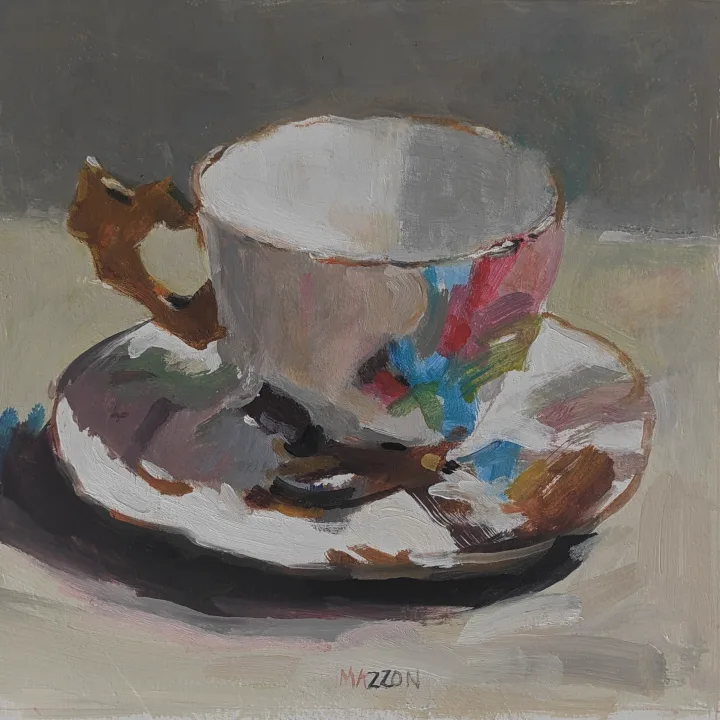
Featured Artwork
Teatime II
Own a piece of Massimo's work. Currently available for purchase.
View Painting