Synthetic Realism: A Painter's Manifesto
Synthetic Realism
A Painter's Manifesto
Massimo Mazzon
I. The Name
Painting has always been synthetic. From the moment a hand loaded a brush and laid color against a prepared surface, it produced not reality but a made thing, something constructed, deliberate, and apart from the world it represents. The history of painting is, among other things, the history of how honestly each generation has acknowledged this fact.
Synthetic Realism names that acknowledgment directly. The word synthetic does not signal artificiality in the pejorative sense, nor does it invoke the merely decorative. It reaches back to the Greek σύνθεσις, the placing together of distinct things into a coherent whole. And realism is not abandoned but re-examined: not the naïve claim that painting can reproduce what the eye sees, but the deeper commitment to a painted image that is honest about what it is and alive to the world from which it draws.
The synthesis is between these two recognitions: that painting is a constructed object, and that it remains, irreducibly, a response to visible reality. Neither term dissolves the other. They hold each other in productive tension, the way, in a well-made sentence, sound and sense resist resolution into one another while remaining inseparable.
II. What the Tradition Offers
Every painter inherits. The question is not whether to receive the tradition but how to hold it: with gratitude and discrimination, neither as dead weight nor as a catalogue of licenses. Synthetic Realism draws from several streams without belonging entirely to any of them.
From the Synthetist painters of the late nineteenth century, those who sought to move beyond imitation toward a language of essential form and color, it takes the principle that a painting need not describe in order to be true. From the discipline of direct observation, from painting from life and the long tradition of the figure, it takes the conviction that the visible world remains inexhaustible. From the legacy of modernism it takes a willingness to let the means of painting be visible, the stroke, the edge, the decision.
What it refuses from each of these: the Synthetist tendency toward mere decoration; the academic realist tendency to make the painting disappear into its subject; the modernist tendency to dissolve the image into pure material gesture. Synthetic Realism wants the image and the paint, the world and the making, simultaneously present.
III. Mimesis and the Painted Form
Μίμησις, mimesis, is the oldest term in the philosophy of painting, and the most misunderstood. Its reduction to mere copying was already a distortion when it was current. In the Poetics, Aristotle does not describe mimesis as reproduction but as a form of making: the artist does not copy what is but renders what might be or what is of such a kind. The mimetic act is selective, shaping, interpretive. It produces not a double of the world but a ποίημα, a made thing, that illuminates the world by standing apart from it.
Plato's suspicion of painters was, in its way, a compliment: he understood that the painted image does something that mere copying cannot do. It makes a claim about what is essential. The painter who draws a figure does not trace the particular person but reaches, through particulars, toward a form that the particular instantiates. This is not mysticism but craft, the practiced ability to see through the individual instance to the structural truth that makes it visible and recognizable.
Synthetic Realism inhabits this understanding. The figure in a painting is not a document of a specific body but a distillation: color, tone, and edge organized to produce the sensation of a living presence in a lit space. The landscape is not a topographic record but a rendering of how light and atmosphere constitute what we call a place. The image is real in the way that understanding is real, not as a copy but as a clarification.
IV. The Flat and the Tactile
We live now in a world that generates images relentlessly: screens, feeds, reproductions, digital surfaces that simulate depth while remaining irreducibly flat. This is the visual environment into which every painting made today is received, not a neutral ground but a context that has altered the viewer's perceptual expectations.
Synthetic Realism does not ignore this context but does not capitulate to it. The painted surface remains tactile in ways the screen cannot be: it holds the record of the brush's pressure and direction, the layering of transparent and opaque passages, the physical deposit of pigment in oil that constitutes light not by emitting it but by reflecting it. These qualities are not nostalgic, they are formally distinct, and that distinction matters.
At the same time, the flatness that digital culture has sharpened in the contemporary eye is not simply an impoverishment to resist. The awareness of the picture plane, of the image as a made surface rather than a window, belongs to honest painting. A Synthetic Realist painting acknowledges both: the sensory density of oil on board, and the frank two-dimensionality that is painting's structural condition. The illusion of depth is offered and withheld simultaneously, as it always has been in the greatest painting.
V. Διάθεσις: The Order Beneath
Every painting that holds together does so because something has ordered it. The ancient rhetoricians called this διάθεσις, the disposition of parts into a coherent whole, the arrangement that gives a work its internal logic. In rhetoric it was the art of placing arguments so that each prepared the ground for the next. In painting it is the distribution of tone, color, mass, and direction that guides perception and produces meaning.
This ordering is not always consciously imposed. The painter who has looked long and carefully at enough painting develops a felt sense of compositional necessity, an intuition about where a mass belongs, where the eye needs to rest, where tension must be introduced to prevent inertia. Διάθεσις operates through the hand and the eye before it reaches the articulating mind.
What Synthetic Realism asks of itself is that this order be genuine rather than formulaic. Not the application of a compositional template, but the discovery, in each particular image, of the arrangement that this image, and no other, requires. The figure demands to be placed where the light places it. The landscape finds its horizon where the weight of sky and earth reach equilibrium. These are not rules but recognitions, and the painter's training is largely the education of the capacity to make them.
VI. On Beauty Without Extravagance
Pericles, in Thucydides' account, described the Athenian character with a phrase that has stayed with me: φιλοκαλοῦμεν μετ' εὐτελείας, we love beauty with simplicity, or more precisely, with a frugality that has nothing poor about it. The Athenians did not pursue beauty through excess but through discrimination: the knowledge of what was necessary and what was not, and the discipline to include only what was necessary.
This is a painter's principle as much as a civic one. The temptation in painting is always toward more: more detail, more incident, more demonstration of facility. What Synthetic Realism holds against this temptation is the conviction that the most powerful paintings are those in which every element earns its presence, in which nothing could be removed without loss, and nothing is present merely to display the painter's ability.
Simplicity of this kind is not poverty. It is the result of long looking and hard editing, of the willingness to let a passage of flat, quiet color do what elaborate description cannot. The paintings I find most compelling, and toward which I am always working, are those that arrive at the essential with the appearance of ease, concealing the discipline that produced them.
VII. A Practice, Not a Program
A manifesto is always a provisional document. It records where a practice stands at a given moment, not where it will end. Synthetic Realism is not a fixed system but an ongoing negotiation, between observation and construction, between the sensory immediacy of paint and the formal demands of composition, between what the world offers and what the painting requires.
The paintings made from this negotiation, figures in interior light, landscapes at the edge of San Francisco Bay, the long-enduring subject of the human face, are not illustrations of a theory. The theory, such as it is, came after the practice and from it. I paint, then I understand something about what I have painted, then I paint again with that understanding absorbed but not worn visibly.
What remains constant is the commitment to the medium in its full particularity: oil paint on board, applied and revised and sometimes removed and applied again, in a studio where the light changes and the silence makes thinking possible. And the commitment to the visible world, the figure, the place, the quality of afternoon light in a specific room, as the inexhaustible source from which painting continues to draw.
The image is not a copy of the world. It is a response to it, considered, constructed, and offered back.
massimomazzon.com
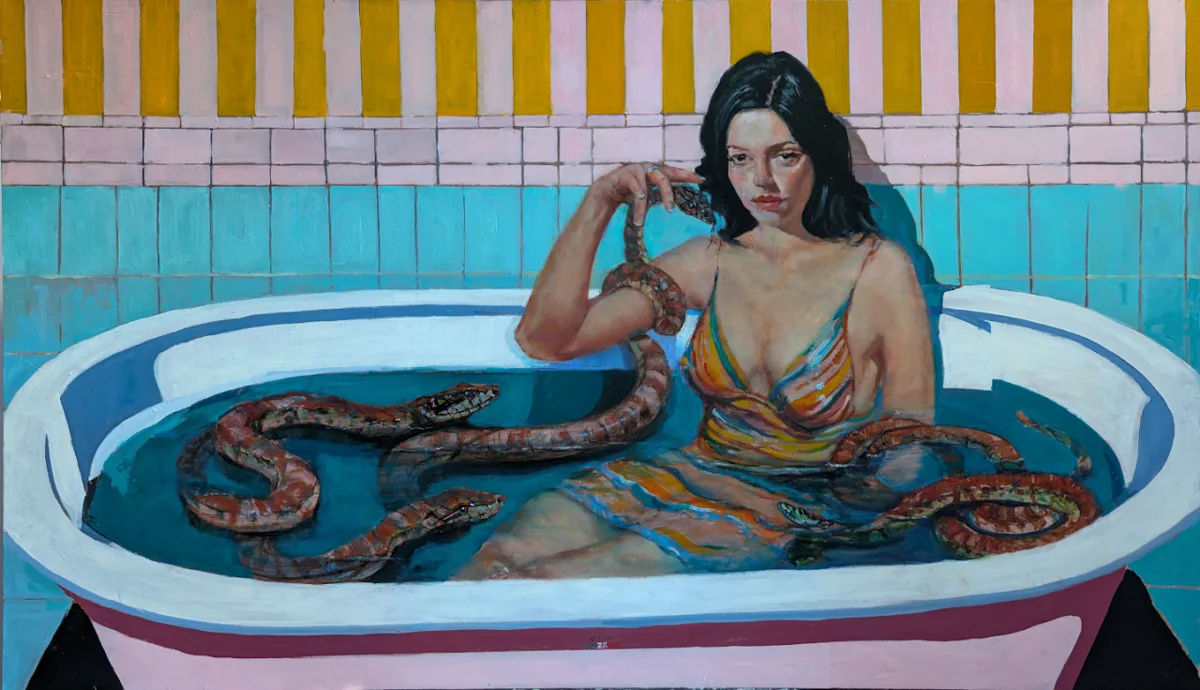
Featured Artwork
Medusa
From a private collection. Browse the studio for works currently available.
View Painting